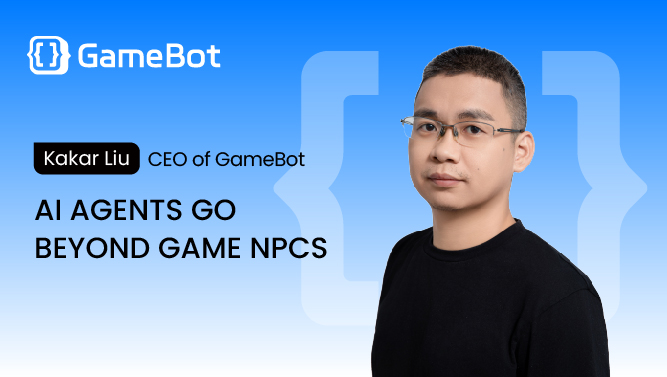
GameBot CEO Kakar Liu: We Have Entered the Game Agent 3.0 Era

In a recent interview with QbitAI, a Chinese tech media, GameBot’s CEO Kakar Liu said the industry has entered the “Game Agent 3.0” era, where AI characters are no longer just human-like but increasingly
He explained how GameBot’s agents now support everything from PVP teammates to PVE level design, and how intelligent NPCs will reshape future AI-native games.
Kakar also predicted that AI agents will eventually expand beyond games into real life—leading toward a future where a billion people coexist with ten billion AI companions.
Read the translated full interview below.
.jpg)
What defines the ideal GAME Agent?
For Karka Liu, founder & CEO of GameBot, it is "one that you can't distinguish whether you're interacting with a human or AI."
As a company focused on Game AI, particularly the development of game agents, GameBot has observed that NPCs in games are now capable of deceiving players into believing they are interacting with humans.
Yet, AI NPCs represent just one facet of game agents’ potential.
Game agents can integrate into the entire game development pipeline, embedding intelligence into game design and advancing the emergence of AI-native games.
Recently, Liu shared his insights during the live stream series "AI Applications Across 365 Industries" by QbitAI. He discussed four key dimensions of game agent evolution, alongside practical applications and industry perspectives.
01
Simulating Player Experience with AI
QbitAI: Let's start with your journey. In 2019, what opportunity led you to found GameBot and provide AI solutions for game studios?
Karka Liu: Frankly, we didn't chase an opportunity. Back in 2019, AI wasn't as popular as it is today. People were talking about the "AI winter," and mainstream AI fields were focused on image processing for security and autonomous driving. At that time, we were working on game-related AI at Tencent, which was a relatively niche area, but we achieved some significant milestones, such as the Go AI “Jueyi” and the Moba AI “JueWu” for Honor of Kings.
These projects showed me gaming's unique appeal: immediate feedback as algorithms evolve, making AI more lifelike. We coined "AGI (Artificial General Intelligence) in Game" internally—a rare vision then—inspired by AI's human-like potential in games. This became our mission: "To create living AI," advancing agents' autonomy and interactivity.
We didn't initially plan to offer solutions to game developers; we just found this work fascinating. Early on, we had an internal slogan: "AGI in Game." At that time, DeepMind was already discussing the concept of AGI, but very few others were. From our perspective, AI in games had the potential to behave very much like humans. "AGI in Game" wasn't just an idea—it seemed like a path worth exploring. So, we wondered if we could venture out to develop AGI.
This mindset also shaped our mission—Create Living AI. We wanted to make game agents more autonomous and interactive, and we've been working towards this goal ever since.
QbitAI: You mentioned earlier that you were very interested in this project from the start, and we also know that GameBot is currently doing some work related to agents. What services and collaborations does GameBot provide to game companies today?
Liu: After founding the company, we realized we had to consider the practical aspects, like the daily operations, so we needed to focus on solutions that could be implemented. One of the easier things to implement, which was quickly accepted, was providing AI teammate or opponent services for large-scale PVP games. This was our first commercial collaboration, and it worked quite well.
Later, we discovered there were also good applications in PVE. AI in PVE is relatively new. Previously, people thought PVE and AI were unrelated, and for a long time, we also thought so. But when we dug deeper into the industry, we found that PVE game designers need to prepare much more levels, especially for action games like boss movements or actions, which require a huge production cost.
By integrating AI into the design phase—essentially allowing AI to train other AIs, simulating players to go through game levels and fight bosses—we could evaluate whether the level design was reasonable and whether it delivered the user experience designers aimed for. User experience is something that can't be quantified easily, but AI can play a big role in this. This is something we explored in deep collaboration with the game development teams.
Thirdly, we are also exploring AI+game-related projects. Currently, we're focusing on large-scale commercial games, but we are also working with smaller indie games. For example, we are applying our NPCs in dynamic worlds. The demand side seems very attractive, but in reality, the technical challenges of implementation are huge.
QbitAI: Today, GameBot is considered one of the largest third-party AI NPC suppliers. The topic of AI NPCs has been quite popular in recent years. Why did the AI NPC business evolve separately from the gaming business?
Liu: Last March, we released the demo for Living Chang'n City, and the NPCs presented in that demo attracted attention from the industry. Many people reached out to us, but we're still hesitant to call ourselves the largest NPC supplier. We appreciate the recognition, though. From both a long-term trend and our own plans, we know that there are still some key experiences that are in the technical challenge phase. Right now, we consider ourselves to have moved from Game Agent 2.0 to 3.0; 2.0 focused on anthropomorphism, and 3.0 emphasizes interactivity, autonomy, and diversity.
QbitAI: Why can NPCs stand alone as a business?
Liu: There are two main factors. First, small-scale games that incorporate NPC interactions exist both in China and abroad. For instance, there are simulation games with virtual girlfriend interactions. Internally, we see these as similar to Stardew Valley-style experiences but adapted for smaller projects. These types of small-scale games can attract players in the short term, but maintaining long-term engagement through fresh content can be challenging. Second, large platform-based games, which are inherently massive in scale, integrate NPCs to introduce new gameplay experiences. These are often tied to operational events or activities to offer players something different on the periphery of the main gameplay.
Our approach lies somewhere in between. We hope to move forward, but we won't start by working on a large-scale game, given the risks AI itself carries. The risks of AI amplify the risks in games. The larger the game, the more stringent the risk management is. Large-scale games find it difficult to accept the uncertainties that AI currently brings. Our focus on NPCs is to solve more medium- and long-term problems, not just deliver a one-time experience where players quickly play and leave.
02
The Suspicious Robot is Actually a Human
QbitAI: Is there a difference in the AI NPC technology used across different game genres?
Liu: There might be a gap in understanding here. We've always been working on game agents, and internally, we don't think that different game genres need different technical approaches. We have been advancing and refining our technology along the main evolutionary path of game agents, with the core principle being the progression of that main line.
Initially, our game agents could only understand simple 2D environments, such as board games or other basic scenarios. Gradually, they evolved to handle more complex 2D games, like MOBAs. From there, they progressed from complex 2D to simple 3D environments—similar to today’s mainstream battle royale games—which we internally classify as simple 3D. Later on, they became capable of adapting to more complex 3D environments with greater depth and intricacy.
What outsiders or clients directly notice are the different game genres. Internally, however, we are very clear and focused on advancing along the main evolutionary path of game agents. At different stages, we adapt or tweak certain rules to fit commercial scenarios, allowing the same core technology to be applied across different genres.
QbitAI: In your description, the AI NPC seems quite similar to what we understand as AI teammates or opponents. Technically, is there a difference between AI teammates and AI opponents in games, or are they essentially the same?
Liu: Based on most of our past deployment experience, especially from 2020 to 2023, anthropomorphism has been very important. In game scenarios, game agents need to exhibit more human-like behaviors, behavior patterns, reactions, and even intensity—they need to feel close to human.
We’ve also conducted many Turing tests and found an interesting phenomenon: players often complain that they’re playing with lots of bots, but when we investigate, the “bots” they suspect are actually real humans.
After 2024, AI development accelerated significantly, and players began expecting more from AI. In the past, AI felt like rigid robots with simple, predictable patterns. Later, with the rise of anthropomorphic AI, players could feel the improvement. From 2024 onwards, both players and game developers started demanding even more—they want AI to provide different experiences, not just simple human-like behavior, but richer interactivity, support for multimodal communication, and a wider variety of behaviors.
QbitAI: Technically, how do you make an AI bot or game agent feel more human-like?
Liu: For an agent to feel truly “alive,” it needs to satisfy two main aspects. First, autonomy—the agent must be able to make decisions based on the situation and its environment. Second, interactivity—it needs the ability to interact with players, other agents, and the environment. I believe continuous improvement along these two dimensions is essential.
Currently, most agents are quite strong in autonomy; they can make excellent decisions even in complex scenarios. However, AI is still relatively weak in interactivity. Some agents only take simple voice or video inputs, which isn’t enough. There’s still a lot of work to be done to advance interactivity in game agents.
QbitAI: In your vision, do you have a specific image in mind for future agents?
Liu: If one day you can’t tell whether you’re interacting with a human or an AI, that would probably be the ultimate goal! It’s actually quite challenging—much harder than simple conversation. Conversation, to some extent, can already be considered to pass the Turing test. But when you factor in interactivity, maintaining consistency across multiple output dimensions becomes a huge challenge.
QbitAI: If all NPCs or bots eventually evolve into highly advanced agents, will our online games turn into a virtual world where AI companions and humans meet?
Liu: It's hard to predict how it will evolve, and the endpoint is not clearly visible right now. Personally, after discussing with some people in the gaming industry, I think the overall trend is like this: nowadays, our phones are smart, cars are smart, even furniture is becoming smart—everything is getting smarter. Now, games, being something users spend a lot of time experiencing, will naturally lead to the demand for smarter game characters or NPCs. This is a natural trend.
In this case, future game characters will form bonds with players in a way that’s very different from before. It won’t just be through character design, detailed modeling, or engaging storylines—it will come from a new dimension: intelligence. Because agents have memory and reasoning abilities, they can make the player’s gaming experience fundamentally different. This is a change at the foundational level. With stronger base capabilities, it’s hard to predict exactly what kinds of systems or mechanics will emerge on top, but it’s definitely exciting to look forward to.
QbitAI: Does every AI NPC need to be specially customized?
Liu: NPCs are essentially game agents. When NPCs are implemented in a game, the intelligence of agents is distributed across different levels. In simple terms, there are many NPCs, but not all of them need a high intelligence level. Otherwise, the experimental costs and delays would be very hard to manage. This is a challenge we must overcome between theory and practice.
NPCs are categorized and tiered. The lowest-level NPCs don’t require much time—they can be generated in bulk with minor adjustments to their settings. Higher-level, more important NPCs, however, need to be customized.
QbitAI: What specific elements are customized for these NPCs?
Liu: Elements like character design and interactions are essential. We also include some unique aspects, such as relationship chains. For high-level NPCs, we focus on their relationships with other characters—who is whose mentor, who is whose spouse, and how these relationships develop. These relationships affect the AI’s future decisions, so they need to be carefully customized.
03
More Agents Will Enter People's Lives in the Future
QbitAI: What do you see as the difference between the “AI-native game” concept people are promoting and the traditional “Game + AI” approach?
Liu: That’s a tough question. I can’t definitively define or set a standard for what makes a game truly “AI-native.” But one point is worth considering: whether AI is deeply integrated into the entire development pipeline.
In the past, AI engineers had little involvement in the game pipeline. The project manager would schedule the game’s modules and push the project forward. Only at certain stages would they hand specific requirements to external AI teams to implement—then it was considered “game AI.”
With AI-native games, the approach is different. The project manager may first break down requirements, some of which need AI to deliver outputs that in turn affect downstream scheduling. We follow this approach now, but it comes at a high cost, because AI introduces many uncertainties that create significant challenges for existing game pipelines and project management.
QbitAI: You mentioned before that AI games need to start from the bottom-level architecture to have an impact. In the process of creating an AI-native game, what is the first step from the bottom-level architecture?
Liu: Take character design as an example. Traditionally, the focus is on backstory, modeling, interactions, animations, special effects, or the storyline. Now, we pay more attention to the “intelligence” dimension—things like short-term and long-term memory, environmental perception, and actions that can change the environment. These aspects become part of the development pipeline. The smarter the character, the more vivid and richer the user experience can be.
QbitAI: Do you think the role or importance of NPCs in games needs to be continuously increased? In what ways should they improve, and what does that mean for AI-native games?
Liu: I don’t think it’s urgent, nor do I think we necessarily need to raise the “importance” of NPCs. Many people equate AI games with making NPCs smarter, but I’m cautious about equating the two. AI technology emerging doesn’t automatically create new gameplay or mechanics, though I do believe combining AI with games can create new experiences.
Integrating AI into games isn’t simply about giving NPCs a higher status. Intelligent NPCs are just one ingredient. Think of it like cooking: before, you might have had four ingredients, and that defined the dish. Now you have an additional ingredient, but what kind of dish you make still depends on the chef’s skill.
QbitAI: Today’s games are mostly guided by creators who control the design direction. If a game were entirely generated and led by AI, could it produce a lot of irrelevant content, making the experience feel cluttered or messy?
Liu: That’s a great question. Many people have asked me something similar: “There are so many martial arts novels now—could an AI take the text of a novel and fully simulate the story?”
We discussed this internally. Take The Legend of the Condor Heroes as an example—it’s engaging, exciting, and full of compelling plot twists. But if AI were to simulate it, would we want to see Guo Jing and Huang Rong doing trivial everyday tasks all the time? Do we really need daily routines like washing their faces or brushing their teeth? Many people imagine that intelligent NPCs will lead to much more content, but it’s important to generate meaningful content from the bottom up.
Most people think top-down approaches work best. But top-down is exhausting, resource-intensive, and very hard to maintain when the content becomes large—it’s difficult to update or modify. A purely bottom-up approach also won’t produce engaging, endless content. If AI is left to randomly simulate everything, the results will be extremely dull and boring.
To make intelligent NPCs truly change the game experience, we need a better combination of top-down and bottom-up approaches. The upper layer—story planners—sets the main plot and key story nodes. The lower layer—intelligent AI—can fill in details within that structure.
You can’t just give AI a starting point. If there’s only a start and everything else is random, the output is completely chaotic. Instead, if you give AI a series of nodes—A to B to C to D to E to F—it can generate some randomness between the nodes, which works well. Whether the full storyline from A to F is exciting or compelling still requires human guidance. In this process, AI acts as a helpful assistant rather than doing everything on its own.
QbitAI: So, in this way, the game would still be playable and also enriched by AI-generated content.
Liu: The upper layer still needs human involvement. If, in the future, NPCs at the lower level become more capable, they can give the upper layer greater creative freedom. This allows humans to design more complex storylines, with dramatic twists and turns supported by technology.
Why are narrative-driven games so labor-intensive to produce today? Because every layer—from top to bottom—has to be clearly scripted. Script-driven content is complex, with huge systems and mechanics, and as the content scales up, its flexibility disappears. Intelligent NPCs, however, can provide a powerful, controllable foundation that makes this process more manageable.
QbitAI: Let’s look at this from an industry perspective. Why do you think gaming will be one of the industries most transformed by generative AI? And how does AI’s importance in gaming differ from other sectors?
Liu: I can’t really speak for other industries. For us, developing game agents allows small teams like ours to iterate effectively. Agents are deployed directly in gaming scenarios, where we can continuously collect user interaction feedback. This feedback is incredibly valuable—it helps the AI improve its interactivity and autonomy. Our development cycles are relatively short and manageable, which lets us focus our attention on refining the Agents themselves.
QbitAI: There's been a lot of emphasis on the diversity and high quality of data in the gaming industry, which makes it ideal for training models.
Liu: Game environments are indeed complex. In practice, we have seen that in some complex scenes, the way agents respond and perform is truly remarkable, something that even I, as a human, might not be able to do. This could also be one of the surprises that AI technology brings to the gaming world and the digital universe it represents.
QbitAI: Over the years in the gaming industry, have you encountered or do you expect any technologies that could have a milestone-level effect in the industry, something truly impressive?
Liu: Even though we collaborate with game teams daily, we are fundamentally an AI company, and gaming is just the main scene where our Agents are applied. AI technology alone doesn’t create milestones in an industry. Real breakthroughs require a “human touch”—teams with creative ideas—to spark the chemical reactions that lead to transformative change.
Disruptive innovation and technological revolutions are rare. What we can do is ensure we have many experimental samples; even if the success rate is low, good innovations still have a chance to emerge. Right now, we need to venture into deeper waters for more exploration. Earlier, smaller-scale, simpler attempts were mostly operational experiments. Moving forward, we want to focus on deeper areas like content and user experience.
QbitAI: With the rise of large models, the search industry has almost been completely transformed. Do you think that the development of large models will have a similarly huge impact on the gaming industry?
Liu: First, I don’t fully agree that large models have completely transformed search. It’s true that many people now use AI-based search, but tools like Google still meet most users’ everyday needs.
As for the impact of large models on gaming, I think it will be a gradual process—you need to find the right integration points and advance step by step. The influence of AI on games follows a chain: initially, AI features and styles may be incorporated into large-scale commercial games. If users respond positively and these AI-enhanced games become more common, the impact gradually spreads to PC games, Steam titles, and beyond.
QbitAI: Lastly, I'd like to ask you to share your thoughts on the future direction of agents and AI, considering where we stand right now. How is GameBot navigating this path?
Liu: Our vision hasn’t changed. In the future, more and more agents will enter people’s daily lives—like in Star Wars, with all kinds of beings coexisting: human-like, robotic, animal-like, and so on. We already have more robotic dogs, and soon there will be even more consumer robots.Game agents will also move beyond virtual environments into the real world.
This will happen in stages. Internally, we define four phases: AI Agent 1.0 through 4.0.
●Before 2020 – AI Agent 1.0: Agents were mainly applied in competitive gaming, with a basic level of intelligence for participating in games, but their abilities were relatively simple and singular.
●2020–2023 – AI Agent 2.0: Competitive ability and adaptability improved, and Agents began moving toward human-like behaviors. Their actions and performance in games became closer to human players, spanning from 2.5D to 3D, and eventually 3.5D game environments.
●AI Agent 3.0 – Current Stage: Anthropomorphism evolves into diversity. autonomy and interactivity are continuously enhanced, allowing agents to deliver differentiated, humanized, and personalized experiences.
●AI Agent 4.0 – Future Stage: Agents will exist in a hybrid state, combining virtual and real elements. Game agents are very likely to move from games into real-world applications, ultimately realizing our vision of 1 billion people coexisting with 10 billion AI.